Skip to content

Changelog_

Explore Appwrite's changelog to stay on top of all the product updates and track our journey.

  1. Buy domains and host DNS inside your Appwrite organization

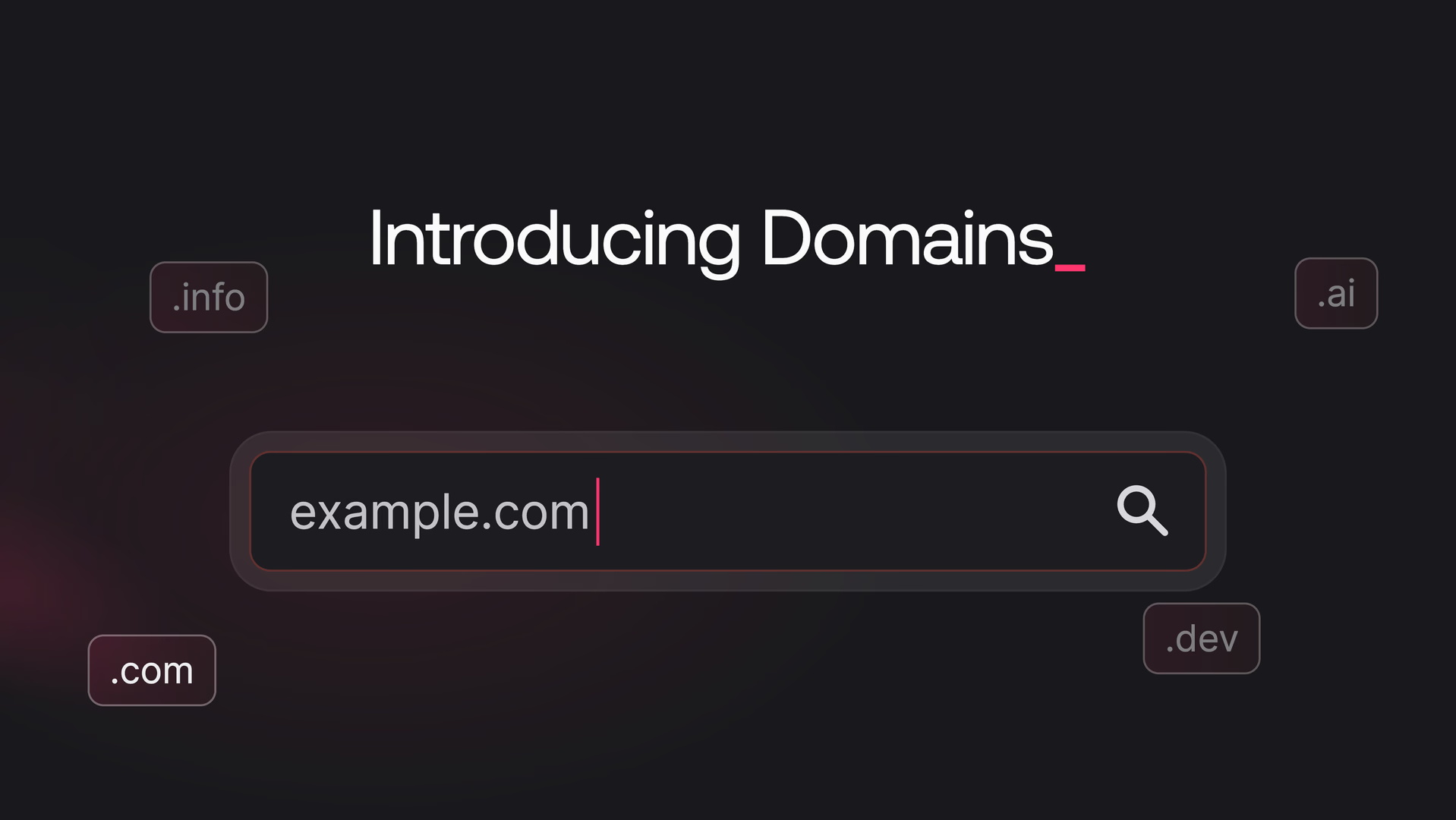
    Appwrite Domains is now available on Appwrite Cloud. Open Organization > Domains to register a name across more than 160 TLDs, transfer an existing registration in, or add a domain you keep registered elsewhere by pointing its nameservers at ns1.appwrite.zone and ns2.appwrite.zone.

    Verified domains get an authoritative DNS zone you edit in the Console, with A, AAAA, CNAME, MX, TXT, NS, SRV, CAA, HTTPS, and ALIAS records, BIND zone file import and export, and one-click MX presets for Google Workspace, Outlook, Mailgun, Zoho, ProtonMail, and iCloud. Records that carry routing and TLS renewal are locked so they cannot be edited away.

    Attach hostnames to Sites, Functions, and custom API endpoints from the same zone, and Appwrite issues and renews the certificates. Auto-renewal, registrar transfer out, and moving a domain to another organization you own all live on the domain Settings tab.

  2. Console IV brings appwrite.io and the Console into one app

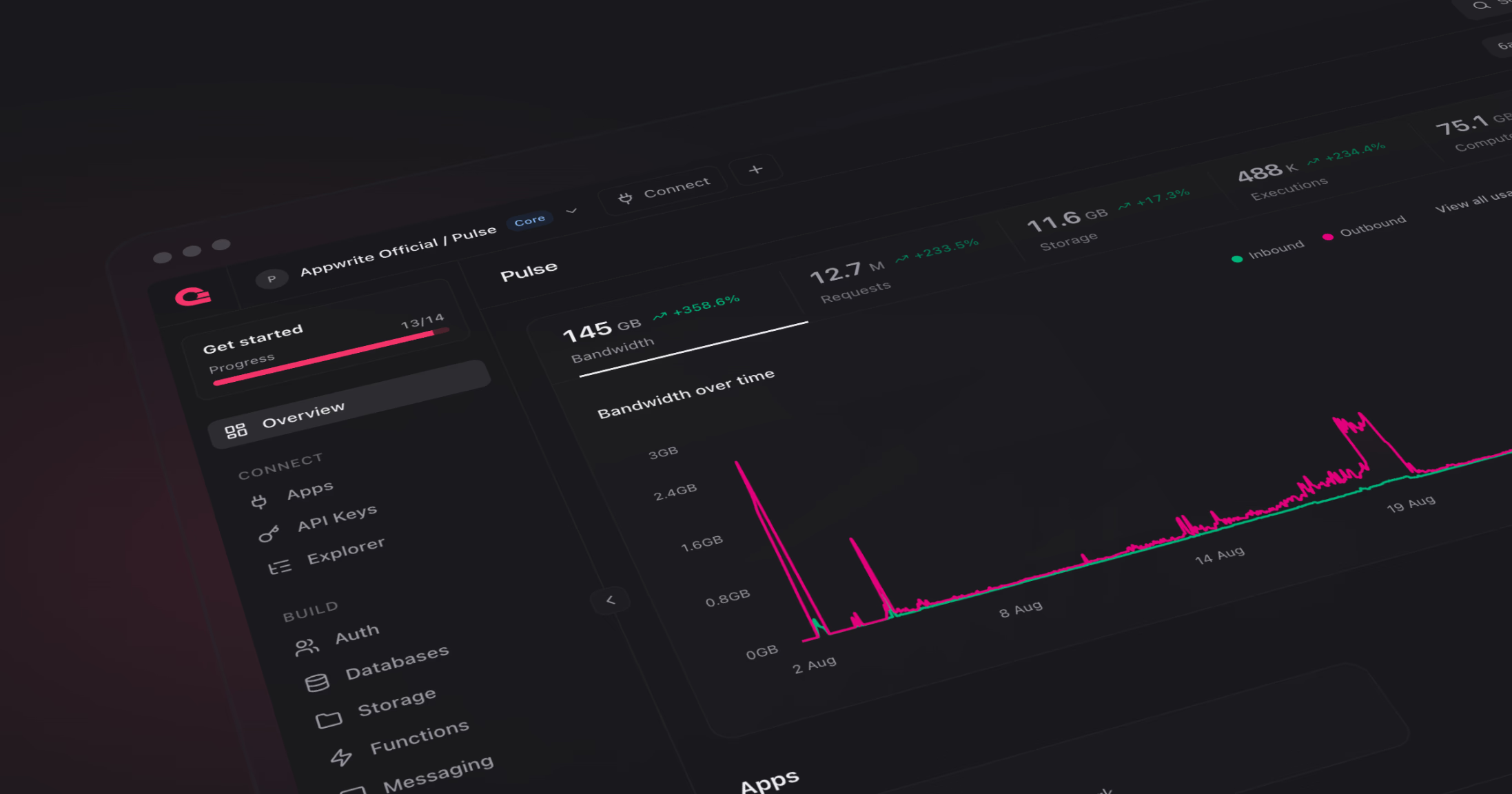
    Console IV is the fourth generation of the Appwrite Console, rebuilt on TanStack Start with React, Tailwind CSS, and ShadCN UI. It replaces the two codebases behind appwrite.io and the old Console, so the marketing pages, documentation, blog, changelog, and every project route now run in one application.

    Docs links inside the Console open a resizable pane next to the page you are on, with their own breadcrumb and back navigation, so you can read the guide without losing the form you were filling in. The Command Center works across account, organization, project, and docs scopes, and Search documentation is available in all four.

    Console URLs changed shape. The /console prefix is gone, and the region and typed-resource segments went with it, so /console/project-fra-68a1c2/auth/user-9f3d0b is now /projects/68a1c2/auth/users/9f3d0b. Old links redirect to their new equivalents. Your API keys, SDK code, and the way your applications call Appwrite are unaffected.

  3. Bun 1.4 is now available for Functions and Sites

    Bun 1.4 is now available on Appwrite Cloud as a runtime for Appwrite Functions and Appwrite Sites. Pick bun-1.4 when creating a function, or select Bun 1.4 as the build runtime for any Node-based Sites framework.

    Bun 1.4 is the first release of Bun written in Rust instead of Zig. It reports Node.js 26 compatibility, starts faster, uses less memory, and installs dependencies quicker than Bun 1.3.

    In our deployments of a Next.js app with 640 packages, builds on Bun 1.4 were 22% faster than Bun 1.3 and 29% faster than Node 26 with npm.

  4. MCP documentation embeddings now refresh daily, independent of version releases

    The Appwrite MCP server now refreshes its documentation embeddings on a daily cron. When Appwrite documentation changes, that context is automatically reflected in appwrite_search_docs and in the AI tools that use it.

    This refresh runs independently of Appwrite version releases. Docs can iterate as soon as they ship, without waiting for the next product version to rebuild embeddings. AI tools therefore work against current Appwrite guidance on a daily cadence, not a release cadence.

  5. Better tool search and clearer schemas in the Appwrite MCP server

    The Appwrite MCP server has a set of improvements. These improvements help AI tools find the correct Appwrite tool quickly. They also help AI tools call each tool correctly on the first try.

    • Search results show enum values and object shapes: If a parameter accepts only some values, the search results show these values. For example, a relationship type shows oneToOne|manyToOne|manyToMany|oneToMany. If a parameter is an object, the search results show its keys. The model does not have to guess valid inputs.
    • Full parameter descriptions: The server does not truncate parameter descriptions. Important details, for example query limits and formats, stay complete.
    • More accurate search results: The tool search removes results that do not match the query. The tool search also matches different forms of the same word. The words row and rows find the same tools. A query for "read rows with pagination" finds list tools, not only single-item tools.
    • Suggestions for incorrect tool names: If a tool name is almost correct, the error message shows the closest tool names. The model does not have to do a new search.
    • Fewer round-trips: The result previews are larger. A typical list response fits fully in the tool result. An extra read of the results resource is not necessary.
    • Clearer errors for unparsed responses: Appwrite can accept a write operation, but the response can fail to parse. The error message now says that the operation was probably successful. It tells the model to make sure with a get or a list call before a retry. This prevents duplicate operations.

    These improvements are available on the remote MCP server at https://mcp.appwrite.io/ and on the local MCP server for self-hosted instances.

Ready to build?_